Monday, 18 January 2016

Kitchen life 1

Over the past months we have been wrestling with a couple of kitchen problems.

First tea. From time to time my tea, particularly first thing in the morning, has been having a most unpleasant taste. We decided that there were a number of possibilities. The hardness of the south London water. The water taking up an unpleasant flavour from the kettle - evidence in favour of this one being that we once had a holy-rolling neighbour who was convinced that plastic electric kettles, at that time only recently invented, did this. The brand of tea bags. Something wrong with the (semi-skimmed) milk. Failure to rinse the soap out of the tea cup (actually a mug) properly when washing it up. One might think that a concerted programme of experiments would have rapidly got to the bottom of the matter, but that did not seem to happen. However, the present theory, not disproved for a couple of weeks now, is that leaving boiled water in the kettle and then reheating it, some time later, is to blame.

We also think that the unpleasant brown film which often develops on the surface of the tea and is then apt to stick to the side of the cup is probably down to the hard water and nothing to do with the unpleasant taste - despite the unpleasant appearance. Doesn't happen when we are in Devon, where the tea, incidentally, has a quite different flavour.

Second scones. From time to time the tea time (cheese) scones do not rise properly. Again, there were a number of possibilities. Dough handled too much or rolled too much. Too much or too little liquid. Wrong sort of liquid, that is to say too high or too low a proportion of water in the milk. Scones rolled out too thin. Too many scones to the tray, thus slowing down their cooking, which might affect the rise. Wrong sort of cutter, crimping the edges too tightly. Was it the wrong sort of cheese? Was the real problem the fact that either the cheese, or the milk, or both had taken passage through the freezer in the garage? All sorts of possibilities, and in this case, as we do not make scones that often, we have not yet got the bottom of the problem.

In fact, we drifted onto a quite different problem, the problem of the provenance of our scone cutters, old enough to be made out of regular steel rather than stainless steel or plastic. Did they date from our marriage or did we take them over from one or other set of parents? Then there was the complication of which cutters had handles. I certainly remember using a cutter of the sort we have now when I was a child. But dredging around in other fading memories, we think the answer is a mixture. Most of our present set of cutters date from our marriage, but one of them came from my mother's kitchen. Then, as now, 85% of the use is cheese scones, 10% is mince pies and 3% is other. For example, jam tarts. The balance of 2% is a margin for error.

From where it occurred to me that maybe we had stumbled on the origin of some of our odd craft customs. Once one has got something, for example making a date and walnut cake or planting broad beans, to work, you get your apprentice to do exactly as you do. With no attempt to be clever and work out which of the many and varied steps are actually necessary and which are not. With the result that, with drift over time and over the generations, some large part of what is done might come to be quite irrelevant to the outcome, but quite essential to the ceremony. The apprentices must never get the idea that they can play fast and loose with the protocols handed down to them or who knows where things will go. They must stick with what is handed down.

From where I associate to a story about pumpkins, brought to my attention a couple of weeks ago. A certain sort of pumpkin decided that it needed its seeds to be dispersed a long way and that large herbivores were the way forward. So the pumpkin added a poison to the mix, enough to deter small herbivores, like mice, but not enough to bother large herbivores. And all was fine and dandy. But then there was a mass extinction or something - perhaps it was the Yucatan hit (see reference 1) - and all the large herbivores in area in question disappeared, and with them the vehicles for long way dispersion. The pumpkins have struggled on, are still producing the poison and are still deterring the mice. But presumably without the success that they once had. Not helped either, I suppose, by the arrival of humans who have messed around with the ecosystem in other ways.

A nice example of evolution not always getting it right. Or, if you are of that persuasion, the divinity not always getting it right. Or at least not bothering with non-essential maintenance. For the full story ask bing - or google - about 'gourds and squashes cucurbita spp adapted to megafaunal extinction and ecological anachronism through domestication'.

Reference 1: https://en.wikipedia.org/wiki/Chicxulub_crater.

Sunday, 17 January 2016

The paperkeeper's tale

At one time when I was in the world of work, I knew about paperkeepers. And at another time, I knew about paper records. I even have dim memories of rack after rack of ancient files in the basement of what was then the Treasury building, running along Great George Street. Some had important markings like 'Secret' and some had great wax seals hanging out of them. But mostly they were just old, dusty and unlikely ever to be looked at again.

So I was pleased to come across the short story illustrated left, a story about the death of a junior paperkeeper by one Máirtín Ó Cadhain, perhaps one of the very last serious writers to write in Gaelic, the last gasp of a thousand year old tradition. A story which evokes the lost world of registered files in their file rooms, before those files were, for most practical purposes, swept away by the photocopier; a story which many old civil servants like myself will relate to.

Published by the Dalkey Archive Press (see reference 1), the name being a nod to another famous Irishman, Flann O'Brien (see reference 2), with the support of the Illinois Arts Council, of all people. I have not investigated the connection.

Published in a parallel text, from which one learns that there is plenty of vocabularic overlap between the Gaelic of Ireland and the English of England. So 'páipéar' is paper and 'Stáitsheirbhís' is civil service. Perhaps I will even get around to learning something about Gaelic, a language of the same vintage as ancient Greek. See reference 3.

A wonderfully entertaining story, even in translation. From which I only share the snippet that the Irish civil service, at that time anyway, was almost a caricature of our own, from which, of course, it had been cut away. Perhaps, having been cut away, it sort of froze in time, froze until its new masters had the time & energy to attend to such back-office stuff. I imagine that the Indian civil service of the same time would also have so seemed.

The book should be made required reading for all departmental records officers.

Reference 1: http://www.dalkeyarchive.com/.

Reference 2: http://psmv2.blogspot.co.uk/2015/09/a-tale-of-two-conveniences.html.

Reference 3: http://psmv2.blogspot.co.uk/2015/08/aryans.html.


Saturday, 16 January 2016

Mainly Schubert 2

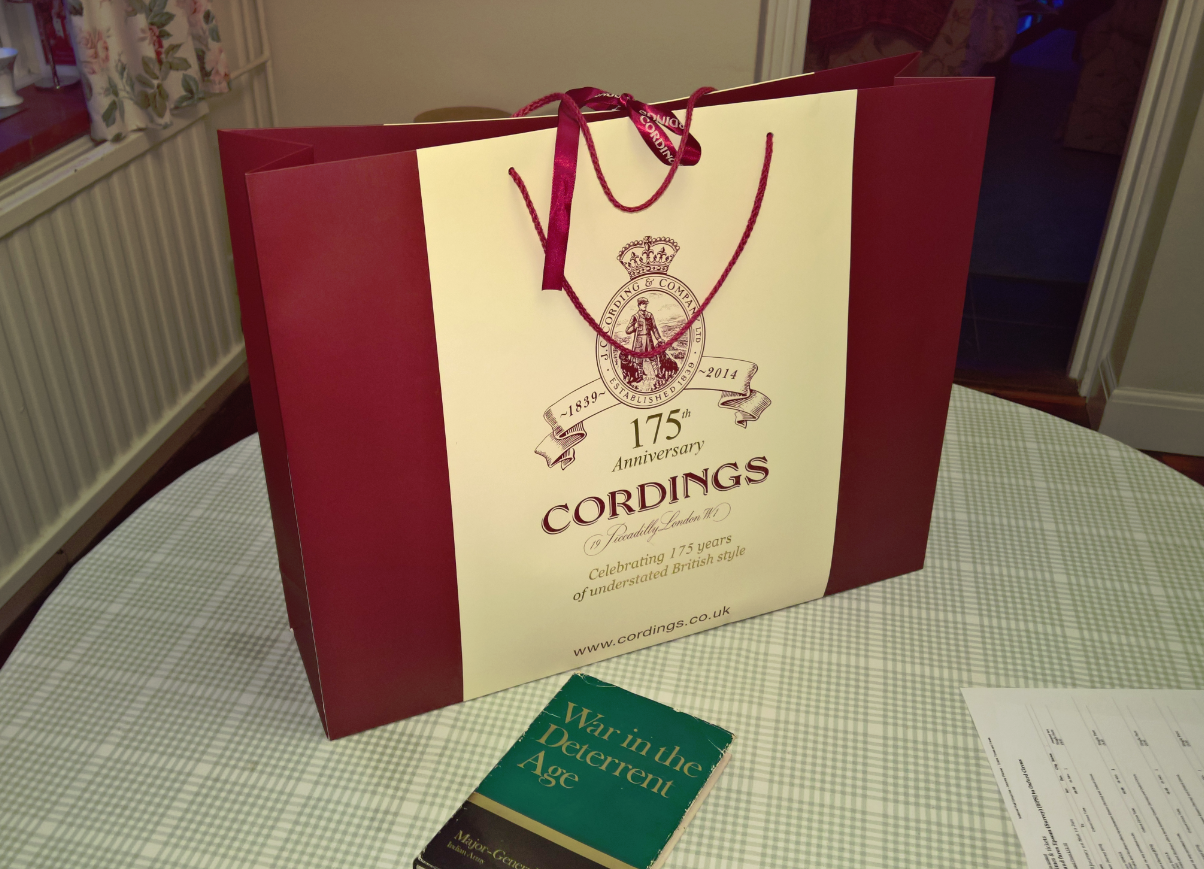
The all-important bag from Cording's, graced with a pick-me-up from the Raynes Park platform library. Notice that, for some reason, they affect to omit the apostrophe, despite the name on the brass plate being Cording, not Cordings.

The book is probably rather out of date, but it is, nevertheless, an interesting aperçu into how senior professional soldiers, this one once a general in the Indian army, think about things both tactical and strategical. With a bit of added interest on account of Graves and Sassoon. Vide supra.

Mainly Schubert 1

Last week to the Wigmore for one of their lunch time concerts, on this occasion to hear (for the first time) Daniel-Ben Pienaar give us three Chopin études, a ballade, some warming up Schubert (from D780 and D935 No.2), then the main course, a late piano sonata. D959.

On the way we had the continuing puzzle of the wire mesh barriers, the sort often used to fence off building sites, underneath the canopy of Epsom Station. Were bits falling off? Was it just left over from some operation of some weeks ago?

Then, having got to Wigmore Street, we had the crush of fashionistas leaving some event which was something to do with London Fashion Week. Hordes of bright young things in fancy dress.

And so into the full Wigmore. The concert started innocuously enough, but for some reason, the D959 really got to me and I had really got going by the start of the second movement, illustrated. It was not as if it was the first time that I had heard the piece and we will have to wait to see if it has the same effect when we next hear it, probably from Richard Goode in the RFH. On which occasion we are going for all three late sonatas in one sitting. I dare say Goode will last the course but we shall see whether we do - a bit doubtful if I get as worked up as I did on this occasion. I have tried the gramophone but only a pale imitation. I sample YouTube with headphones - the same performer - Kempff - as I type. Later: better, but not right to listen to such stuff while doing something else.

Out to a light lunch at the Debenham's sub-ground bistro, a pleasant a place as ever. Not too busy, plenty of cheerful and young efficient staff.

From where we went on a swing through the fancier part of the west end in a hunt for a new rain coat - something regular clothes shops don't seem to understand about any more - on the way taking in the Fine Arts Society winter sale - with the Society failing to draw blood, that it to say, failing to draw my credit card out of its Mulberry. But there was a small watercolour by one Inchbold, featured in an episode of Morse, in which he was doing quite different stuff.

Tried downstairs at Burberry's but that was pretty hopeless - as well as being outrageously expensive. But then we chanced upon Cording's, which did still raincoats, albeit a little shorter than I would have really liked. I could also have bought a riding coat, a contraption made out of a fabric involving an internal rubber sheet, undoubtedly waterproof but a rather heavy coat. I had owned one in the past - from Pinder & Tuckwell, lately of Exeter, but I was not tempted to try again, partly because the shop man, who owned one himself, explained that they needed to be looked after. Something that I don't do with clothes.

The deal was that if you bought one of their very grand carrier bags, you got a free garment with it. And so we were sold, with a quick visit to the National Gallery to run down the musical madonna to wind up the proceedings. See reference 3. Apart, that is, from the 88 bus to carry us off, for a change, to Vauxhall Cross.

Reference 1: http://www.cordings.co.uk/. Slightly put out to find a puff from Damien Hirst there.

Reference 2: http://danielbenpienaar.com/.

Reference 3: http://www.psmv2.blogspot.co.uk/2016/01/goya-not.html.

Friday, 15 January 2016

Amaryllis

Our festive amaryllis is now about half out. The telephone did a reasonable job on it, if one is not bothered by the yellow tone added to the background by the flash - which I have still not learned to control.

I thought that I might have taken its picture before, on previous years, but search failed to turn anything up, beyond the couple of references given below. Maybe my spelling is a bit irregular.

Reference 1: http://psmv2.blogspot.co.uk/2015/12/father-christmas-came-early.html.

Reference 2: http://psmv2.blogspot.co.uk/2015/03/grave-error.html.

Restraint

There were two cases of death while or around restraint in yesterday's papers, one involving policemen who were called to deal with someone with mental health problems, the other involving security guards at a nightclub dealing with someone else of the same sort. Both cases have progressed to manslaughter charges.

My first thought, in the police case, was that it seemed a bit heavy handed to deal with the matter with the full weight of the criminal law. The policemen involved were presumably doing the best they could - but got it badly wrong, or at least it went badly wrong. So my second thought was should this not be a matter for internal investigation & action, certainly in the first instance? Third thought, perhaps it had been and the internal inquirers thought there were serious charges to be answered and passed the matter to the CPS. Are the police very sensitive to accusations of cover up, and so, when in doubt, they pass the buck and leave those involved to sink or swim as best they can? Although, that said, I imagine their trade union will be helping.

The security guard case is different, with the security guards probably having no established internal procedures of their own. Presumably the police and then the CPS decided that there was a case to answer.

So the bottom line is, not enough information and one can only hope that the courts come to a sensible decision.

But I am still left with a nagging worry that we, as a society, are getting far too ready to pull the gun of legal, in this case, criminal action, forgetting that the law can be both a very blunt and a very expensive instrument. Good for the lawyers though.

Thursday, 14 January 2016

Stop tweet

Just tweeted a gold finch in the back of the garden next door, courtesy of my Christmas monocular, kept handily to hand. Had at first thought, without optical assistance, that it was a redwing, as seen in more or less the same spot in previous years. See reference 1. But it was a goldfinch and a very handsome bird it was too, not often seen (by me anyway) around here - or for that matter, anywhere else. See reference 2 for the last recorded sighting.

PS: as it happens, today's Guardian carries a picture of a goldfinch on its letters' page, opposite an article about the strange love affair between our governing classes and trident submarines - something which the corby the crow has got right. Along with sundry other, much more respectable people. Surely the governing classes can't all be on kick-backs from the contractors that build the things?

Reference 1: http://psmv2.blogspot.co.uk/2013/12/tweet.html. And other posts nearby.

Reference 2: http://psmv2.blogspot.co.uk/2015/04/spring.html.