A bit more than three years ago I read a chuck out from Sutton Library called 'Ambling into History' by one Frank Bruni, a serious journalist who spent serious time on the Bush (the younger) battle bus during Bush's campaign for the presidency in 2000, a campaign he ultimately won by a whisker, amid much controversy about the minutiae of the machines used for counting the votes in Florida. My report at that time is to be found at reference 1. Book now reread after having taken a serious dose of West Wing, that is to say, series 1 and series 3, completely overlooked when they came around on UK TV, seemingly more than 10 years ago now, but picked up last year at a Hook Road car booter - or some such.
While I stand by what I said first time around, the serious dose of West Wing does seem to have brought the whole thing more to life.
Covering a presidential campaign from close quarters, getting plenty of time with Bush, his wife and his team, was not for the faint hearted. Long hours, many of them spent in or in waiting for buses and aeroplanes, many of then spent on media driven froth and nonsense, many hotels and, by the sound of it, far too much food laid on. One also spent enough time with or near Bush to get to know him and to get to like him. And leaving his politics aside, he was a likeable guy in private, which was one thing - he also managed to pull off the rather harder trick of being a likeable guy in public - a trick which the loser, Gore, did not manage. Then there was the trade off between knocking the man in your stories and continuing to be friends, to get access and the odd plum. It must have been hard to be in the campaign in the way that Bruni was, without becoming part of it.
Being the presidential candidate was not for the faint hearted either. One also needed some special skills, to have some special qualities and to be very keen indeed - on which last point, some doubted whether Bush had it - but, as it turned out, he did.
Bruni is interesting on the tension between the need for a candidate to be likeable, to be one of the chaps, one of the boys, to be a wow at kissing babies and tossing pancakes, and the need for a candidate also to appear to be all knowing, all knowing about all manner of things. An all knowing which can only come, in reality, from quality briefing from quality support staff, as neither candidates nor presidents can afford to spend much of their own time on that sort of thing.
He does not speculate in this book on whether there is a mismatch between what it takes to get elected and what it takes when one has been elected. I started out thinking that there was, but now I am not so sure. In our sort of democracy, maybe the two things go together, and many of the skills one needs to get elected are needed when you have been elected. Both before and after you need, for example, to be very good with people in general - and with the press in particular. You have to be able to win hearts and minds. You have to be able to delegate. You need to be able to cope with a large chunk of your life being lived in public, either with the public at large or with the many inhabitants of your outer office. You have to have a family who will put up with up it all.
We enjoyed West Wing, excellent light entertainment, entertainment which, incidentally, seemed to square with what little I knew about the goings on around high office from my time at the Treasury. I now think that it also squares with what Bruni has to say about the goings on around presidential campaigns - with there being clear read across between some of the scenes in the series and some of the scenes in the book,
Maybe the next stop is series 7, at which we baulked on the first attempt. Too much seemed to have changed since series 3. The US accents seemed to have become too strong for our older ears. So perhaps we should wait until some car booter or charity shop comes up with the intervening series.
Reference 1: http://pumpkinstrokemarrow.blogspot.co.uk/search?q=ambling+history.
Reference 2: https://en.wikipedia.org/wiki/Frank_Bruni.
Wednesday, 13 January 2016

LEA
I was reminded by some advertisements in yesterday's Guardian that we once had things called local education authorities. There was even the big daddy of them all, the Inner London Education Authority, sometime purveyor of education to (the often deprived) children of inner London and sometime employer of BH.
Reminded because the Guardian carried several advertisements from outfits like the 'Outwood Grange Academies Trust' (aka OGAT), which appeared to operate at the same sort of scale as the LEA's which they appeared to be displacing. Some at least of which also appeared to have chief executives who had been head teachers and who were now on very fancy salaries.
Turning up the website for Outwood (reference 1), I find that they talk of family in rather the same terms that Walmart talks of Asda. Lots of management speak. They also have a well staffed senior team, presumably very roughly the same sort of people who would have otherwise staffed up the upper reaches of an LEA, albeit on fancier salaries. Digging a bit deeper I find some small print: 'OGAT is a company limited by guarantee and an exempt charity. This means we are regulated by the Department for Education rather than the Charity Commission. Our academies are funded by the Department for Education on a per pupil basis in the same way as maintained schools. Embedded below are our annual accounts'.
I took a peek at the latest accounts to find that, oddly for an outfit which had appeared to work on presentation, that the accounts came as a rather carelessly scanned image, rather than as a proper pdf file. But they were legible and as far as I could make out they had a balance sheet of around £100m, presumably almost entirely the schools which they had been given, and a turnover of around £40m, presumably mostly the salaries of the staffs of those schools.
Taking a peek at Surrey, I find the comparable figure for turnover (if I have read the runes aright) is around £400m, ten times the size. So the academies have got a way to go before they push the LEA's off the raft altogether.
Time will tell whether they make a better fist of things - but my present take is that around 50 LEAs were perhaps a better place to start than several hundred trusts. Certainly a better basis for planning area provision.
And will they morph from a sort of charity to a sort for-profit outfit? Get some proper incentives in place so that we can really get things moving (for David and his friends from the Bullingdon Club).
PS: the same edition of the Guardian also included very heavy coverage for David Bowie. More, perhaps, than they accorded Margaret Thatcher on her death. Leading me to wonder whether this master of self-publicity had signed off on the whole package before he 'passed over'.
Reference 1: http://www.outwood.com/.
Reminded because the Guardian carried several advertisements from outfits like the 'Outwood Grange Academies Trust' (aka OGAT), which appeared to operate at the same sort of scale as the LEA's which they appeared to be displacing. Some at least of which also appeared to have chief executives who had been head teachers and who were now on very fancy salaries.
Turning up the website for Outwood (reference 1), I find that they talk of family in rather the same terms that Walmart talks of Asda. Lots of management speak. They also have a well staffed senior team, presumably very roughly the same sort of people who would have otherwise staffed up the upper reaches of an LEA, albeit on fancier salaries. Digging a bit deeper I find some small print: 'OGAT is a company limited by guarantee and an exempt charity. This means we are regulated by the Department for Education rather than the Charity Commission. Our academies are funded by the Department for Education on a per pupil basis in the same way as maintained schools. Embedded below are our annual accounts'.
I took a peek at the latest accounts to find that, oddly for an outfit which had appeared to work on presentation, that the accounts came as a rather carelessly scanned image, rather than as a proper pdf file. But they were legible and as far as I could make out they had a balance sheet of around £100m, presumably almost entirely the schools which they had been given, and a turnover of around £40m, presumably mostly the salaries of the staffs of those schools.
Taking a peek at Surrey, I find the comparable figure for turnover (if I have read the runes aright) is around £400m, ten times the size. So the academies have got a way to go before they push the LEA's off the raft altogether.
Time will tell whether they make a better fist of things - but my present take is that around 50 LEAs were perhaps a better place to start than several hundred trusts. Certainly a better basis for planning area provision.
And will they morph from a sort of charity to a sort for-profit outfit? Get some proper incentives in place so that we can really get things moving (for David and his friends from the Bullingdon Club).
PS: the same edition of the Guardian also included very heavy coverage for David Bowie. More, perhaps, than they accorded Margaret Thatcher on her death. Leading me to wonder whether this master of self-publicity had signed off on the whole package before he 'passed over'.
Reference 1: http://www.outwood.com/.
Tuesday, 12 January 2016
Jelly lichen?

It has a matt rather than a silk finish and the habit is not quite the same, but then that might be just down to it growing on a twig, even in this damp weather, rather drier than the bit of patio in question, apt to become a spring or a stream bed when it is wet. Wet enough, in fact, that the three small ponds are presently one. Readers can remind themselves about the ponds at reference 2 - and looking at the snow there, be amazed that it dates from very nearly the same time of year that we are at now.
Reference 1: http://pumpkinstrokemarrow.blogspot.co.uk/search?q=extravagant+plants.
Reference 2: http://psmv2.blogspot.co.uk/2013/01/the-frozen-wastes-of-surrey.html.
Sassoon not

I think it must have been the first of the three books that I read as a child, at that time not being that interested in the fox hunting which occupied most of the book, rather in the first world war trenches at the end. The second rather shorter book is entirely trenches, while the third, shorter still, is more by way of an epilogue: Sassoon going back to war after his protest (see below) and ending it with a further wound on the Western Front - as it happens, the result of one of his own sergeants not having been told that he (Sassoon) was out on patrol in no-mans-land. Also, a vividly recalled near-death experience.
Volume 1 is a tale from another world, a world in which young men could drop out of Cambridge after a desultory year and knock about in the Kent countryside on a modest private income, passing the time away with cricket in the summer and hunting in the winter. Oddly, the grandson of a banker from the now near vanished Jewish community of Baghdad, with a father who was largely disinherited for going native and named for his mother's love of Wagner. And who, while hunting, had a devoted groom, who was content to live for the hunting glory of his young charge. a groom who despite being quite old, old enough to stay out of it, volunteered for the army shortly after his young charge, and died of pneumonia in France.
I think Sassoon, having started out with a horsey version of the territorials, was able to fit in with the proper, regular officer set of the Royal Welch Fusiliers (entry to which was wangled by a military neighbour), with his fox hunting - and his fox hunting London tailors - standing him in good stead. He comes across as a brave and decent officer, albeit a touch odd, at least a touch different from the others. And a lighter touch than friend Graves of reference 3; a lightness of spirit, a curious sort of schoolboy insouciance - at least that is what he puts into the book. A rather sporting attitude to the whole business - and - like many young men of his class & generation, he knew young men on the other side too.
Volume 2 is trenches and closes with Sassoon publishing an anti-war letter, protesting, I think, inter alia, the absence of any stated war aims which might justify the slaughter. A letter for which he expected to be court martialed, but was, in the event, more or less brushed under the carpet and put down to shell shock.
Volume 3 sees his return to active duty after a spell at the once famous Craiglockhart sanatorium near Edinburgh (run by a nest of Freudians, some of the first on the English block), seeing duty in Ireland, Palestine and then back to France. With the Allenby subsequently made famous by Lawrence of Arabia getting a walk on part.
Sundry incidents of mistreatment and worse of prisoners and of the wounded (of the other side), mostly reflecting the difficulty of dealing with either in the middle of a battle, but the only real crime recorded is a hearsay account of a rather coarse English officer recounting the tale of getting out - and using - a machine gun to calm down some restive Turkish prisoners in a camp - no where near a battle at all.
But there was a rather odd episode - perhaps curious would be a better word - in Ireland, where Sassoon was posted for a short while in 1917. The situation in Ireland at that time was already bad, but Sassoon was still welcomed into the hunt near where he was stationed at Limerick. Hunters clearly have the same sort of open sesame, wherever there is hunting, in the same way as golfers and (more or less) as free masons. Welcome, although warned at some point in his stay - of a few months - that maybe, as an English officer, it would be better if he were to stay away from the coming troubles.
A good read and the three volumes have earned their two inches of prime shelf space. I shall have to find something to recycle.
PS: the term 'open sesame' is a translation of sorts from the supplemental tale of Ali Baba and the Forty Thieves. Richard Burton alleges the original is cabalistic, rather than granular, quoting Joseph Derenbourg in support. See page 370 of volume 4 of the Supplemental Nights (Indian reproductive edition),
Reference 1: http://psmv2.blogspot.co.uk/2015/12/topping-books.html.
Reference 2: http://psmv2.blogspot.co.uk/2015/11/pour-le-merite.html.
Reference 3: http://psmv2.blogspot.co.uk/2015/12/goodbye-to-all-that.html.
Monday, 11 January 2016
Tura

I am fairly sure I have posted her before, but cannot now turn her up, either here or in the other place. Hopefully she will turn up again of her own accord before too long.
Reference 1: http://psmv2.blogspot.co.uk/2014/06/mrs-seacole.html.
Goya not
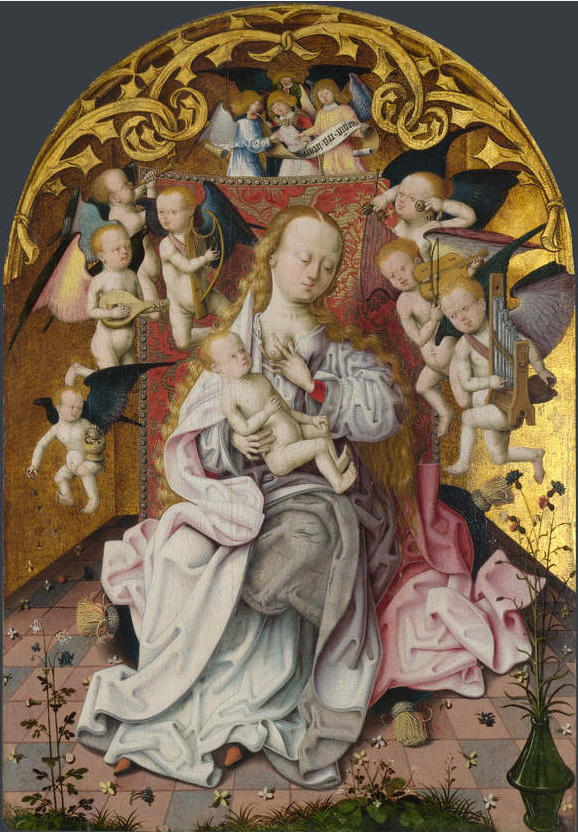
We failed on the Garafalo of reference 1, it having been moved from its last known home in the basement, presumably on account of the building work evidenced by the complex scaffold outside.
But we did find the ambassadors of reference 2 and we did find the adoration of reference 3. The former reminding me of the carpet used as a table drape in the recent performances of Henry IV Part I and the latter seeming oddly subdued in tone. At this point we branched out into art history, as exemplified by the rooms in the middle fifties. Rooms in which there seemed to be trouble with, for example, connecting heads to shoulders - and with the folds of cloth.
I suppose part of the interest in cloth arose from richly coloured cloth being a marker of wealth, so something which patrons wanted to flaunt, something with which one wanted to clothe objects of veneration and something which came to be of interest in its own right. How does one capture the seemingly random folds of cloth in a realistic and interesting fashion? An interest which has survived to our own time, at least in this part of Epsom. But a trick which the master of the St. Bartholomew altarpiece had not mastered in his early work - late fifteenth century - snipped from the National Gallery web site and include above. In the gallery. in the flesh, as it were, the folds around the right (as viewed) hand arm looked particularly odd. An example of the way that the brain can learn, from observation, how cloth should fold, without necessarily being able to articulate what is wrong when it is wrong. The wrongness is hidden in the connections of the millions of neurons which look after the folding of cloth and statistics do the business without the need for grammar. Further musings on this fascinating subject to be found at reference 4.
As it happened, we noticed something of the same sort a couple of days later. A chap was walking along the platform at Epsom station and there was clearly something wrong, something odd about the way that he was walking. Inter alia, the rhythm of his steps was all wrong. But more than that we could not say: the brain could compute oddness, but could not display its reasons. I associate now to a chap whom I used to know who made a living out of the fact that neural networks could be quite easily trained to be very good at spotting odd behaviour, behaviour which needed preventitive maintenance attention, in complex machines at Heathrow airport. Again, the network would know that something was wrong, but would not know what was wrong; that bit you had to do for yourself.
We also noticed the elaborate chairs in which some of the saints were placed. Mostly elaborate wooden chairs, but which very much reminded us of the niches in the Lady Chapel at Ely, older than these paintings by getting on for two hundred years. Perhaps they were already anachronisms by the time of these masters. The heritage speak of their day.
While Tura's muse (to be posted next) reminded me of the sort of thing that the writers of fantasy novels and fantasy computer games go in for now. A reference forwards rather than backwards in time.
Out to wander down Whitehall, to wonder outside the Houses of Parliament about whom the large black Mercedes saloon, allowed inside the security perimeter, might belong to. The person whom I took to be the chauffeur would not tell me, would not even tell me that he was not allowed to tell. Perhaps foreign, perhaps diplomatic, as my understanding is that important politicians of our own get driven around in British flavoured cars.
Bused ourselves to Vauxhall for lunch at the Estrela Bar. Some opted for what turned out to be an excellent lemon sole, grilled, while I settled for a substantial portion of a stew involving some sort of bony beef, some red beans and some rice, served in my own private saucepan. Taken with the bread and olives with which we started, a substantial lunch indeed. Washed down with a half bottle of the entirely satisfactory house white called 'Encostas do Bairro '.
PS: despite the interest in 'The Virgin and Child with Musical Angels' evinced above, I was not able to recover it from the excellent online catalogue maintained by the National gallery on their website. I had, for example, already forgotten that the picture was topped with a round arch and it took a further visit to the gallery yesterday to get things straightened out.
Reference 1: http://psmv2.blogspot.co.uk/2012/11/jigsaw-2-series-2.html.
Reference 2: http://psmv2.blogspot.co.uk/2014/05/jigsaw-7-series-3.html.
Reference 3: http://psmv2.blogspot.co.uk/2013/02/jigsaw-9-series-2.html.
Reference 4: http://psmv2.blogspot.co.uk/2015/09/abstract-expressionism.html.
Saturday, 9 January 2016
Sussex pie

The occasion was a brainwave, an opportunity to try some more truffing, truffing to follow up that at reference 1. The brainwave being that one could use slices of truffle instead of the mushroom ketchup as the all-important additive to Sussex Pie, described at reference 2, although I think the record there must be incomplete, as I am fairly sure we were still making the things well into 2011. A pie originally described to me in the Wetherspoons at Tooting, and bearing no resemblance to the pie turned up by google, reproduced in the snip left. Although, name apart, I can only applaud the favourable mention of lentils therein.
So off to butcher in Manor Green Road to see what he could do. Too warm presently for him to be stocking shin, which is what I had hoped for, instead getting a near 3lb brick of stewing steak, quite possibly also known as silverside.
Place a sheet of foil in a baking dish, the dish maybe six inches by nine. Coarsely slice an onion into the bottom of it. Make six incisions into the top of the beef, herringbone fashion, and push half a slice of truffle into each. Add three tablespoons of Sainsbury's ruby port. Fold the foil over, sealing it all up, and place in the oven set to 125C at 0645.
There was a smell of something cooking, maybe mushrooms, around the house quite quickly.
Reduced the temperature to 100C at 0830.
Checked progress and drained off most of the fluid at 1130, something under half a pint, by which time the meat had lost perhaps a third of its original length - while maximum width looked unchanged. At least one truffle slice had escaped from its incision but I did not attempt to return it.
Made a gravy with the fluid by working in a little flour - perhaps a level desert spoon - and bringing it back to the boil. Left on gentle heat.
Oven off at 1230, a little under six hours cooking time. Rested it half an hour, then served at 1300 with carrots, crinkly cabbage (a rather feeble specimen, not, I should think, a savoy) and mashed potato. Plus, of course, the gravy.
Oddly, the onion were not really cooked. They were rather like a meaty version of the onions you get under baked fish. Still a bit crisp, not very nice and left to one side. But they had served to get the meat off the bottom of the dish.
The meat was very good, if rather firmer than I had been expecting, perhaps the result of there having been no fat or connective tissue. Cooking time and temperature about right. The truffles had added nicely to the flavour without swamping that of the meat. Gravy very good as an accompaniment, particularly on the mashed potato, left un-buttered and un-milked for the purpose.
Tip for next time: get shin and get a wider roll of foil. This last to make a better job of the parcel.
Reference 1: http://www.psmv2.blogspot.co.uk/2016/01/truffes.html.
Reference 2: http://pumpkinstrokemarrow.blogspot.co.uk/search?q=sussex+pie.
Reference 3: http://www.masterbutchersepsom.co.uk/.
Subscribe to:
Posts (Atom)