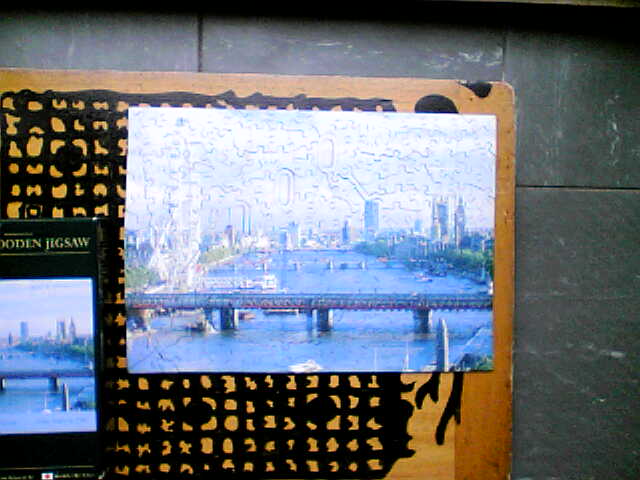
A Wentworth puzzle, originally bought for me, well before the current phase of jigsaw life, around the time of the millennium celebrations. Presumably a little after, as in the image the London Eye appears to be complete, up and running, which it was not at the time of the turn of the millennium. An Eye which had, however, provided much interest & entertainment as I followed its progress on my morning & afternoon walks across Westminster Bridge, this being before I moved up-river to Lambeth Bridge.
A serious puzzle, made from sustainable yield plywood using the traditional Victorian style of cut which is only made feasible in these days of high labour costs by the deployment of the latest computer driven, laser fueled technology. And to think that when I was doing O level physics, lasers were a curiosity for which no-one could think of an application. Traditional Victorian style means that the pieces are not cut on a regular grid in the manner, for example, of a puzzle from Falcon. They are completely irregular, including here the prong configuration, are not fully interlocking and include a lot of whimsies, for example the millennium numerals and various small animals. The large zeroes are just about visible in the enlarged version of the illustration (click on it).
Don't know how many pieces there are, beyond it being a lot less than my usual 500.
The lack of interlocking makes the puzzle rather fragile, even when fully assembled. Poke it and it is apt to come apart, a feature which made it very hard for FIL in his last years, with his elderly fingers and elderly eyes, and before retiring from this particular fray, he had become convinced that various pieces were missing, a conviction which I have to admit to sharing at various times during my solution.
Starting with the edge did not work with this puzzle as one could not be sure which pieces were the edge pieces; having a bit of straight was neither a necessary nor sufficient condition in the way that it is in more up to date puzzle. So started with the wheel then moved onto Hungerford Bridge, the strong horizontal across the bottom of the image. Then the buildings running along the banks of the Thames. Then the other two bridges, then the water in between. Then the water down stream of Hungerford Bridge and lastly the sky. The edge evolved along the way, but was complete shortly before the sky was complete.
An entertaining diversion from the usual run of puzzles from the Oxfam Shop. And pleased to find from the Wentworth web site (http://www.wentworthpuzzles.com/) that I now have a source for arty jig saws - jigsaws of proper pictures being my favourite, and Wentworth do lots of them, albeit at a price. It may well be that their computer driven, laser fueled technology enables them to make puzzles to order: feed the bit map of the desired image in at one end and plywood pops out of the other, closely followed by the box. Just the thing for a lover of arty jigsaws.
Will it be 'The Hunters in the Snow', a favourite of my father's, or will it be 'Sheep Reposing, Dalby Bay, Isle of Man', which appears to be a contemporary crib from 'Strayed Sheep', a reproduction of which hangs above this very keyboard?
Monday, 17 June 2013
New patio, phases II and III (part 2)
Phase II sits on top of phase Ia, the bit under the cloth in the illustration of 27th May and the bit to the left of the olde shed base in that of 16th June. By way of a shutter, I reused the by now rather split plank which had served for phase Ia, with some cunning additions underneath to make a snug fit and held in place by a sturdy piece of 8 by 2 at each end.
But not sturdy enough as as I started to fill the shutter with concrete, the top of the front plank moved up, the bottom moved out and I did not notice until it was too late to push it back into place and secure it there. I did not fancy digging out the wet concrete and starting again, so I secured it as best I could with lumps of masonry which happened to be lying about and finished the thing off. More or less OK but the front of the sill was well off vertical (although at least it was sloping away, towards the fence) and there were some voids at the bottom where the concrete had not been properly compacted into the void left by the moving shutter, partly because I was scared of it moving even more. Furthermore, when the front of the shutter moved, it came adrift from the chipboard divider, the front of which is now covered by a thin skim of concrete. I suppose I ought to hack it off but I'm scared of making a bit of a mess. We will see how things look when I have filled the voids. Will I pass muster as a concrete finisher, a trade all to itself during my days as a concrete tester?
In any event, the phase II beam was finished off nicely with a layer of pea gravel between it and the fence. All very smart. A wheeze which will not, sadly, do to cover up the olde shed base.
Phase III runs along the base of the west wall of the garage, where the tools are stood up in the illustration of 27th May and the bit to the back of the olde shed base in that of 16th June.
After the mishap with Phase II, I was determined to make this shutter sturdy, with a couple of planks of tongue & groove from the demolished shed, various bits of 2 by 2 and various lumps of masonry serving the purpose. But for this phase (or perhaps lift would be the more correct term, even though lift is the term more usually applied to the successive pours to make a column, rather than a beam which is more usually made in one pour) I fell into the error of haste, thinking that I could get the job done before lunch. As a result the concrete mixing was a bit erratic, with the first few batches being rather dry - and I did not work hard enough at the tamping to clear all the voids at the bottom of the shutter. More concrete finishing needed in due course. Furthermore, the concrete being a bit stiff, did not settle flat and while the two ends are right, the middle is slightly high, maybe half an inch. It shows now, but perhaps when the concrete weathers down a bit and the garage wall is repainted it will not show so much.
Illustration in due course when the concrete finishing has taken its course.
In the meantime, I am pleased to report, that as things have turned out 0.6m of aggregate and five bags of cement was about right. There will be a bit left over, but not much and it will be easy enough to lose the bit of aggregate in the garden and the the bit of cement in the tip up the road. But I do not pass muster as a quantity surveyor, partly because I was changing the design as I went along, without any proper change control; the Young Turks from Pcubed (see http://www.pcubed.com/) with whom I used to work at the Home Office would not have been impressed at all.
PS: it would be interesting to know how things turned out there in the end: was their high end solution right for our mid range problem? Were the techniques used to manage the construction of oily facilities in the wilds of Kazakhstan the right thing for IT in Horseferry Road? What percentage of the budget did they manage to collar before they moved off onto their next punter?
Two portraits
Two portraits from emerging artists from Kent, captured with a more up to date telephone than my elderly Nokia and delivered through Google Sky (rather than the Dropbox favoured here in Epsom). More details to follow.
Sunday, 16 June 2013
Two mysteries
The first mystery concerns the adaptation of Agatha Christie's 'The mirror cracked from side to side', most of which we saw for the third or fourth time last night. How did it come about that the photographer's studio contained what appeared to be a reproduction of Millais' portrait of Mrs Jopling leaned up against a bit of furniture? An entirely suitable portrait for the lady photographer in trousers and of generally modern appearance portrayed, but how did it find its way to the props department?
No clues to be had from checking the original text which says little beyond the studio being rather cluttered with photographic gear.
The second mystery concerns the missing car booter at the Hook Road Arena today. That is to say that it was not altogether missing, but it was the thinnest car booter I have ever seen there. Less than maybe 50 vendors and not many more buyers. What was wrong with this Sunday? The weather was fine enough.
On the up side, two pluses from the garden. We have the first water lily flower, albeit rather a small one, and we have the first sighting for a while of a nut hatch. Used to get them quite often, but not any more.
New patio, phases II and III (part 1)
Full report to follow, but in the meantime I thought a sketch of the proceedings might be clearer than a photograph. Think how many of the pictures in scientific text books are sketches rather than photographs: the camera may never lie but it may not be very information rich either.
So up I get to produce a sketch with pencil and paper, something I can manage on a good day. But today, after two attempts, I thought that I might do better with Powerpoint, with the results illustrated. For me, an essentially new media which, while it has its strengths, seemed rather clumsy in my hands. It probably took rather longer than the production of an equivalent sketch would have taken, had I persisted, and the result is rather lifeless, despite the assistance of a font called 'Bradley Hand ITC' and some imaginative spelling. Furthermore the brain seems to flip-flop between the various spatial interpretations of the scene which are available, rather as it does with those pictures which are intended to trick one. What is the orientation of the various planes and shapes? But I think one might get better with a little practice.
I also need to work on the mechanics of importing a powerpoint into a blog. This one came via Paint and seems to have lost a fair bit of resolution in the process, as can be seen by clicking on the thing. Or was it not there in the first place?
I remember that once upon a time I had a presentation copy of CorelDraw with which I fiddled with a bit, but I do not remember it being any less clumsy than Powerpoint seems now. There was also a glossy picture book that came with it containing the results of an annual contest to produce an orginal art work, most of which were elaborate and colorful but as lifeless as the above. I wonder what packages there are about now? Something that can usefully combine the life of pencil and paper with the power of the computer to draw straight lines, to fill in shapes, to copy, cut & paste? To save and to print?
A short while ago there were some pictures in the 'Telegraph' done by Mr. D. Hockney on his tablet which did not impress. Maybe he did not bother to do a proper market search before kicking off. Maybe he did not have the benefit of access to a small boy with wisdom about such matters. But then, I have never been very keen on his stuff.
PS: see January 14th 2012 in the other place (http://pumpkinstrokemarrow.blogspot.co.uk/) for a previous outing of this subject.
Friday, 14 June 2013
Splice the mainbrace
Decided that the braces from Lester Bowden were not really the thing anymore, elastic gone soggy and the dorsal arrangements unsatisfactory, with the straps forever slipping off the shoulders. Saville Row was clearly the place to go to sort this out.
So picked up a Bullingdon at Eccleston Place and head off of Mayfair. One hairy moment coming around Hyde Park Corner, coming into it from Grosvenor Place and looking to leave it at Piccadilly. The catch, made worse by not knowing the junction very well, is that you head east out of Duke of Wellington Place in a lot of lanes of traffic, among which you think you ought to be in the middle, with traffic whizzing past on both sides. Signalling intentions not on as I want to go straight ahead and while I think there is a hand signal for this purpose I don't know what it is and I don't suppose many drivers do either. So I am pulling away from the lights opposite Apsley House and this chap behind me in a small black car gets really impatient and being uncertain of my intentions overtakes on the right, then cuts me up by veering left ahead of me to head up Park Lane. He also honked, always bad news for this cyclist as it startles one and can precipitate a wobble. Luckily not on this occasion and I found myself unscathed in Piccadilly, and shortly afterwards got mixed up in the one way system in Sackville Street. Two full stands later, I take the last slot in that at Bruton Street.
Into the first tailors that I come across which happens to be Crombies, where I am picked up by an attentive sales assistant. Yes sir, Crombies certainly do sell braces, just the one brand, just as Lester Bowden, but a rather better brand, their own brand in fact. Banker bright, wide front straps not elasticated at all, dorsal arrangements satisfactory. So I buy them and put them on on the spot, the assistant supplying a plastic bag into which to consign the old ones. Just one pair for now to see how we get on but, anticipating, so far so good. Much more positive fit and trousers near clear of shoes, as they should be.
Next stop Queen Mary's Gardens in Regents Park to see the roses, to which I had been alerted by the trusty Bullingdon map (now sadly rather tatty. Don't think that they do them any more). Parked up at the tennis courts, which seemed all very clubby and Hampstead like but I declined to either play or eat, both options being available, and headed onto into the gardens. Roses only just coming out but a very fine place indeed. More floribundas than the rose beds at Hampton Court, so they should be quite flashy in a week or so. Other bits of the gardens also good. All in all, a good find. Must go back when the roses have got going a bit more.
Next stop National Gallery, so off to St Martin's Street (not the Lane) where I take one of the last slots on the stand, and on into the gallery to take a peek at the Cézanne's where I am very taken with a very nice Gauguin copy of a Cézanne still life of fruit, another copy of which I picked up recently from the Oxfam shop in Ewell. Rather crowded but in this corner I was quiet enough.
Next stop South Bank for a late lunch to which end I take one of the last slots on the stand at Concert Hall Approach No. 1, to buy a couple of Moroccan style rolls from one of the stalls there. Wrapping of thin flat bread, filling of chick pea, cous-cous (I think) and spinach. Very good and very filling.
And so home, via W. H. Smith and their not terribly effective self service machinery. A good try, but they have yet to really crack the technology for this sort of purchase in this sort of context. Bring back the bucket of trust!
DSM-5
Prompted by adverse coverage greeting the publication something called DSM-5, the fifth version of a diagnostic and statistical manual for mental illness, thought to get a copy and take a peek myself. But, as it turned out, DSM-5 was a hefty tome clocking in at around £80, a bit strong for a passing interest, so I thought I might do better to get a book about DSM-5 rather than the thing itself and, luckily as it turned out, lit upon 'Saving Normal' by one Allen Frances, not previously heard of. An example of the value-add of the Amazon offering, over and above the book shop which I would not have got to for this particular purpose.
'Saving Normal' turns out to be a decent bit of popular medicine, explaining the background to diagnosis and classification of mental illness and going on to explain what is wrong with DSM in particular and psychiatry US style in general, this from the chap who led the team which gave us DSM-4. His genial and easy going style makes for a mostly easy read, although I found it jarred a bit at times and I expect that he has not been too careful about checking some of the details. But a story which will be interesting to those with an interest in shrinkery - and a useful learning experience for those who think that the American way of health is the right way. Cameron & Co. should take note - although one rather despairs of their ever doing so.
He identifies various things which have gone badly wrong and which could be quite easily put right if the political will was there. He also goes so far as to say that there is a bigger problem with legal drugs than there is with illegal drugs although not quite so far as to say that illegal drugs should be made legal.
One: stop drug companies from advertising their products direct to the public, thereby prompting them to think that they have this or that disease and to ask their hard pressed doctor for this or that medicine. Something which is not allowed pretty much anywhere else other than in God's own country, that is to say in the US. Going further, loosen the grip that drug companies have on the medical profession.
Two: change the health insurance company rule which says that they will not pay out for a visit to the doctor unless the visit results in a prescription. A rule which had the good intention of discouraging unnecessary visits to the doctor but which probably does more harm than good. Going further, encourage doctors in general to take more time over diagnosis and general practitioners in particular to refer rather than prescribe. Psychiatry is difficult and best left to specialists.
Three: tighten up the classification criteria in DSM which presently encourage the classification of people who are well as well as that of people who are ill. Try and get fashions in diagnosis - like that, for example, for autism - under better control. Going further, find a proper home for the DSM. The APA (American Psychiatric Association, see http://www.psych.org/) is clearly not up to producing a manual which is carrying so much weight. And stop using a DSM diagnosis (or lack of one) as such a big driver in decisions about education, support and care.
Various other snippets along the way.
For example, it has been ruled unconstitutional (in the US) to execute people who are dim, with some kind of an IQ test being the test for dimness. So we have the slightly unsavory spectacle of IQ testers determining the final fate of someone who has murdered someone or worse. A determination which might hang on a result falling a point or so either side of a necessarily arbitrary threshold on a 200 point scale. Not sure how you get around the strong incentive to fail such a test.
Interested to learn that DSM started life with the US military, concerned with mental health aspects of combat in the second world war. And full of appropriately trained expatriates from Central Europe.
Frances is a big believer in process and his DSM-4 was very process driven. Interesting to me as the IT industry fell in love with process at about the same time, in the eighties and nineties of the last century. We really believed that it was possible to replace skill and flair by tick boxes - which to some extent it really is. The trick is not to try to push it too far.
Frances is also reasonably pro-Freud. A stance with which I agree because I think that his style, if not his detail, will have its day again when the neurologists have run their course with their neuron models on their big computers.
And he is very pro-psychiatry. He might spend a lot of time in his book knocking present goings on, but he also spends some quality time at the end reminding us that psychiatrists also do a lot of good, mending a lot of lives which might otherwise remain badly damaged.
PS: appropriately, a psychiatric fragment in an otherwise routine office dream. As I woke this morning I had this revelation, blinding light even, that in the course of psychoanalytic work one could work away on some fascinating facet of someone's personality, only to discover that it was a dead end. Cute but without consequence; an appendix of the mind as it were, a relic of evolution. Large computer programs are often full of such things. In the cold light of day, the light is not quite so blinding, but I still think the guts of the revelation might be true. Interesting even.
Subscribe to:
Posts (Atom)


